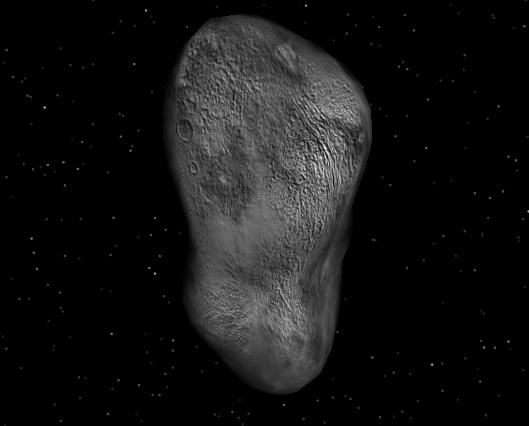
Elara
is the eighth largest moon of Jupiter. With a mean radius of 43 km
(assuming an albedo of 0.04), it's only about 2% the size of Europa,
the smallest of the four Galilean moons.
But it's about half as
big as Himalia, which makes it second biggest in the Himalia group, a
family of Jovian satellites which have similar orbits and appearance,
and are therefore thought to have a common origin.
Elara
may be a chunk of an asteroid (a C- or D-class asteroid, judging by the
fact that it reflects only about 4% of the light it receives), which
was broken apart in a collision either before or after being captured
by Jupiter's gravity.
In this scenario, the other pieces became
the other moons in the Himalia group: Leda, Himalia (the largest) and
Lysithea. A fifth moon, called S/2000 J11, only about 2 km in radius,
was considered a candidate for this group.
However, it was lost
before its orbit could be definitively determined. It may have crashed
into Himalia, reuniting two pieces of the former asteroid, and perhaps
creating a faint temporary ring of Jupiter near the orbit of Himalia.
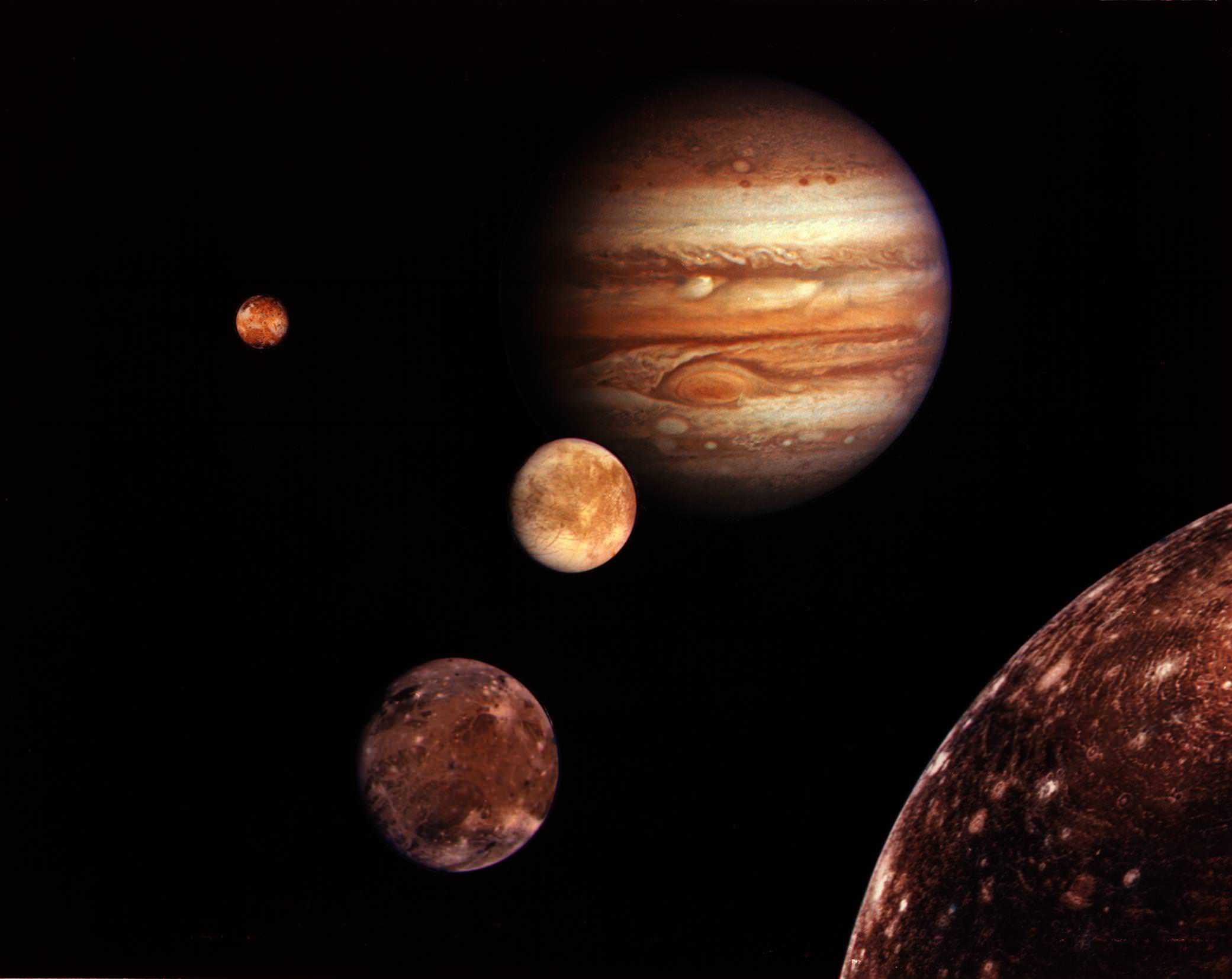
At a distance of about 11.7 million km from Jupiter, Elara takes nearly 260 Earth days to complete one orbit.
Discovery:
Elara
was discovered on 5 January 1905 by Charles Dillon Perrine in
photographs taken with the Crossley 36-inch (0.9 meter) reflector of
the Lick Observatory on Mount Hamilton at the University of California,
San Jose.
How Elara got its name:
Elara
is named for one of the lovers of Zeus, the Greek equivalent of the
Roman god Jupiter. In Greek mythology, Zeus hid her from his wife,
Hera, by placing Elara deep beneath the Earth, where she gave birth to
their son, a giant called Tityas.
A name ending in "a" was chosen for this moon in keeping with the International Astronomical Union's policy for designating Jupiter's outer moons which have prograde orbits (orbiting in the same direction as Jupiter's rotation).